Showing posts with label sefer. Show all posts

Thursday, 10 January 2013

Collectanea of kabbalistic and magical texts.


Edit: from two sources (Lloyd Graham and Rabbi Yosef Cohen) I find this is the famous treatise  Sefer Shoshon Yesod Olam of Rabbi Yosef Tirshom.

This very interesting manuscript was made available in electronic format by the  Library of Geneva (Bibliothèque de Genève), where it is kept, under the name Comites Latentes 145. The extremely careful and comprehensive description on its website was made by Yael Okun, and its existence was brought to my attention by professor Lloyd Graham, to whom I am extremely grateful.
It contains magical, kabbalistical and other miscellanea ranging from the 15th to the 18th centry, by a multitude of scribes. 
This is a short overview of its contents:
Contents:
  • pp. 1-17 Israel Sarug Commentary on the Sabbath hymns by R. Isaac Luria.
  • pp. 21-598 Joseph b. Elijah Tirshom Kabbalistic compendium.
    • (pp. 22-58) Indexes
    • (pp. 60-84) Harba de-Moshe (Sword of Moses)
    • (pp. 85-92) Magical texts associated with Harba de-Moshe
    • (pp. 61-70) (lower margins) in a different hand: Sefer Razim (Book of Secrets).
    • (p. 61) (lower margin): The beginning of Ma'ase Bereshit Rabba.
    • (pp. 93-107) Seder Shem 'Ayin-Bet. A treatise in Arabic on the mystical uses of the Holy Name of seventy-two letters. Seven chapters.
    • (p. 97) An amulet attributed to a R. Menahem
    • (pp. 107-114) A treatise on the invocation of angels who have authority over the seven days of the week.
    • (pp. 115-118) Ha-Ne'elavim Treatise on magical therapies for the treatment of epilepsy.
    • (pp. 118-612) Collection of charms, amulets, holy names and other recipes, mostly magical or kabbalistic and dissertations on philosophical topics.
  • pp. 601-611 Divine Names, Biblical passages and permutations of letters for magical uses.
  • p. 612 At the bottom of a blank page, the copyist, Joseph [Tirshom] added instructions for asking a query of heaven in a state of awakeness, attributed to R. Simeon the Great and other formulas.
  • pp. 613-627 Charms (segulot), amulets, queries to heaven to be answered in dreams and short kabbalistic works in §§109.
  • p. 629 End of a treatise on astrology.
  • pp. 631-653 Collection of kabbalistic and magical pieces.
  • pp. 654-656 (in a different 17th cent. hand): Spells, including incantation bowels with drawings, instructions to exorcise possessing spirits from the book Or Tzach u-Metzuchtzach
  • pp. 657-668 Kabbalistic treatise on the Holy Names. End missing.
  • Pp. 629, 669-672 Treatise on astronomy. Incomplete. 

We reproduce here the pages of interest to us, namely the diagrams and seals (for larger versions, right click and view image).


p.115

p.116

 p.117

p.151

p.152

  p.169

 p.174

 p.205

p.221

 p.222

  p.223

p.238


p.263

 p.280

p.322

 p.323


p.324

 p.401

p.409


p.426


p.448

p.462

p.468

p.516

p.552
p.553


p.599

p.630

p.654


p.670

p.671 

p.672

Saturday, 8 September 2012

Planetary characters in Vital s Sefer HaPeulot

I ve recently came into possession of a little known series of planetary characters found in one of Chaim Vital s little known manuscript works called Sefer HaPeulot, through the ever-surprising help of Rabbi Cohen.

(Pending editing. manuscript information)

He manifested his doubt upon their relation to other characters found on traditional segulot and his suspicion of a tradition more linked to the Sefer Mafteah Shlomo,  due to the lack of circle-ended figures which is the subject of his current studies.


I would like to further strengthen his suspicion and attempt to forward a possible Arabic origin of the seals.
As far as I know there are no practical directions connected to the seals, but an educated guess would be that they were engraved on rings or metallic medals made according to the astrological disposition of the planet in question.

I have three reasons to believe they are of Arabic descent:

-most of the image magic works featuring the septenary of planets are not purely Jewish in nature, but almost entirely Arabic. As there are some evidences about a Jewish tradition of seals and sigils, found in  Shoshon Yesod Olam, Sefer Even HaShosham and a number of Genizah fragments, I will not claim complete certainty here on account of my lack of information, but most of the seals in Jewish amulets are quite dissimilar from our set, while Arabic treatises abound in almost the same type of seals. Not a farfetched claim when we consider Vital s journeys to Egypt and long term studies in Safed and Damascus, where Arabic image magic would have flourished. 


 -the repertoire of the signs is about 28 or 29 recurring symbols (give or take one as a margin of error caused by faulty copying) which lends us to believe the characters are simply names written in a magical alphabet. I will compare the existing alphabets of Arabic origin used in talismans from my collection, including the ones found in the treatise of Ibn Wahshyyah, and communicate my findings.
-the characters themselves have common symbols with other Arabic series of characters, one of the most striking being with the alphabet or secret characters of the Tahatil names. I will append illustrative material as shortly as possible.


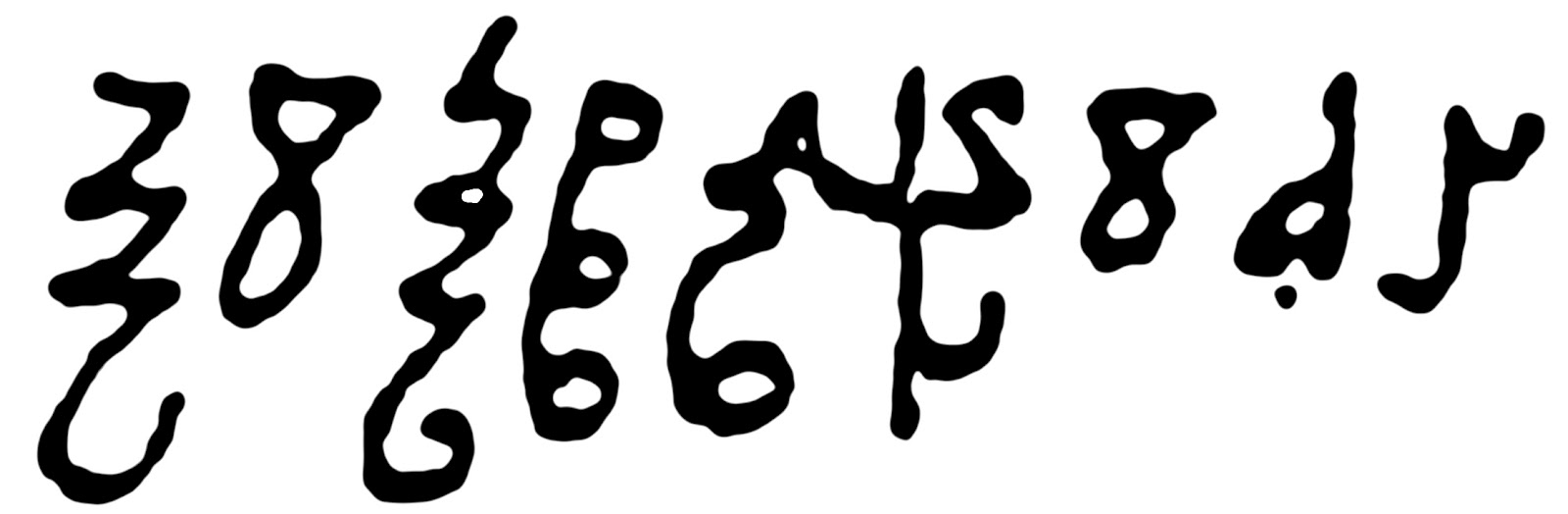
These are the seven character lines in question, cleaned up and enhanced for further study. Once again, many thanks to Rabbi Yosef Cohen for his most cordial help in identifying the attributions.


Seals of Saturn


 Seals of Jupiter


 Seals of Mars

 Seals of the Sun

 Seals of Venus

 Seals of  Mercury


 Seals of the Moon


In my future studies and comparative charts, I will refer to this series of characters as Vital. Each series will be coded with a three letter sigla for the planet (Vital.Sol.,  Vital.Lun., Vital.Mrs., Vital.Mrc. and so forth), while the symbols themselves will be numbered as they appear from right to left. As an example, sign Vital.Mrc.1 appears in quite a number of Arabic charms

1

2


3

As seen in figure 2, it s not a mere cross with crooked circles, but two elongated syllables in Arabic (Hah), crossed one upon the other.  In our series, the vertical line forms the syllable HAH and the horizontal line forms the syllable MU or perhaps HU.