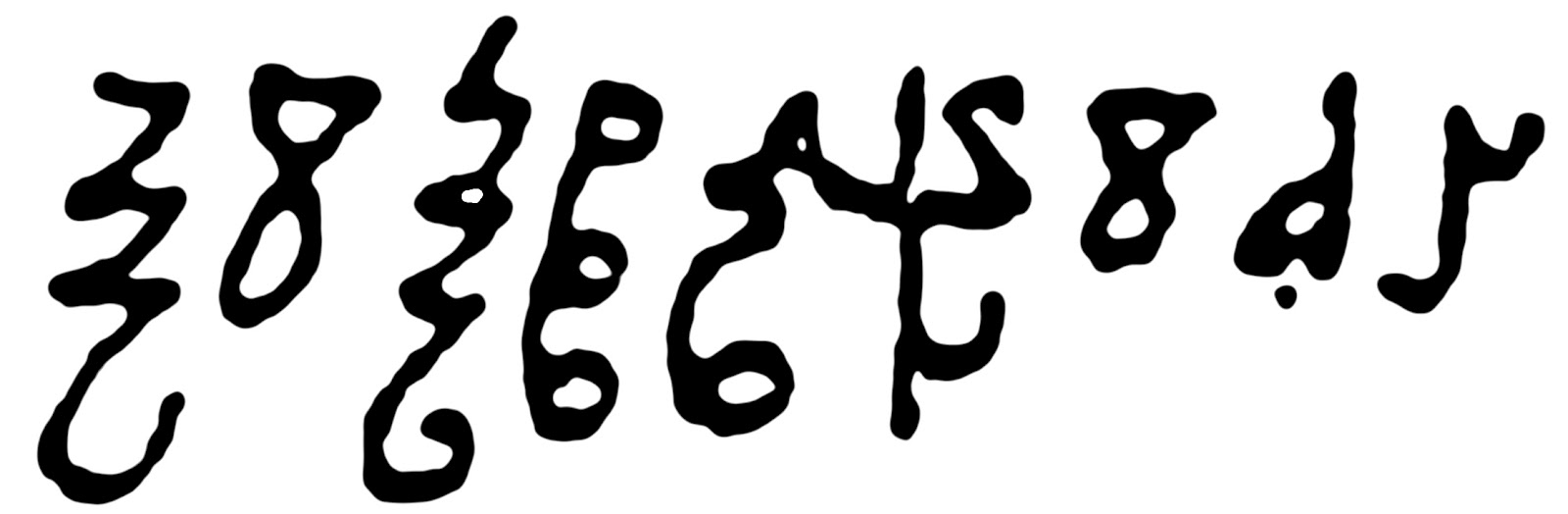
The Magical Calendar is one of the most amazing pieces of art and information available in Western Hermeticism.
It was published in 1620 by Johann Baptista Großchedel its basically a tabular rendition of the correspondences found in Agrippa's Book II, chapters 4 through 14.
The original manuscript used as a source for it British Library manuscript Harley 3420. Adam McLean, who published a wonderful study of it in The Magical Calendar:
A Synthesis of Magial Symbolism from the Seventeenth-Century
Renaissance of Medieval Occultism (Magnum Opus Hermetic Sourceworks
Series) RedWheel / Weiser, 2008, decribes on his website the manuscript:
British Library MS. Harley 3420.
Paper. 1614.
Johannis Baptistae Groschedelii, Dispositio Numerorum magica ab Unitate usq; ad Duodenarium.
Titulus ipsius Codicis: 'Dispositio numerorum Magica ab unitata usque ad
duodenarium. Collecta singularis industria, compilatione diversa, magno
labore, et investigatione sibi suisque, a Johanne Baptista
Groschedelio, Equite Romano, ab Aicha Philomago, Lucisque et Gratiae, et
Naturae indagatori vigilantissimo. Anno 1614.' Opus scil. Artimagicae
et Astrologiae judiciali (ut loquuntur) inserviens: et in suo genere
satis curiosum. [ With coloured figures.]
A good presentation of it is hosted by Joseph Peterson's website, copiously illustrated:
I will present three versions of the seals, my sources being as follows:
MC.1
The 1620 engraving by Grosschedel and DeBry, from McLean and Peterson.
MC.2
The 1614 manuscript Harley 3420, from Peterson.
MC.3
A Dresden manuscript quite similar to the Harley version (in what I can glean from McLean's description, I haven't have the pleasure to inspect the manuscript first hand.)
The entry on it:
'Ein Im[m]erwährender Natürlich-Magischer Calender, Welcher die Beschauung der Allertiefesten und Geheimesten Sachen, Ingleichen die Erkäntnüs der gantzen Philosophie in sich faßet', 1582. SLUB Dresden
Adam McLean seems to think the date is spurious, yet Rafal T. Prinke gives the same date for the version in the Wroclaw Codex. I have not inspected this manuscript either, nor do I have a digital copy, so there is no MC.4, unfortunately.
The order of the angels is quite peculiar, as is their attributions.
In MC.1, the angels are listed from Saturn to Moon, the so-called Chaldaic order of the planets. It rivals in popularity with the week order, as used in the Heptameron. Cassiel, Sachiel, Samael and Gabriel have their normal atributions, that is Saturn, Jupiter, ars and Moon. The others seem miss-matched. Anael is ascribed to the Sun, Raphael to Venus, and Michael to Mercury.
In MC.2, Anael is rightly attributed to Venus, but Raphael is attributed to the Sun and Michael to Mercury, the inverted order of the Heptameron. As Peterson points out, the Heptameron agrees with Agrippa, while the MC agrees with older works such as Liber Juratus and Sepher Raziel. We shal keep this order here. He concludes that the table has been muddled in the engraving: Raphael and Anael are reversed
from the manuscript. This is probably due to the fact that Sol/Raphael/Machen
is split by the binding. (Peterson, Magical Calendar, Seven)
In MC.3 the order is not as expected of a manuscript, in agreement with the MC.2, but in agreement with the later printer version, the MC.1. We could therefore conclude that MC.3 is not an older version from the MC.1, but possibly derived from it.
Seal of Cassiel (Saturn)
MC.1
MC.2
MC.3
Notes: one cannot help noticing that while the seals from the Heptameron have three marks, the seal from Scot has two, we are presented here with only one mark, the first one. The shapes also differ: MC.1 and 2 share the trapezoidal shapes of the Heptameron, while MC.3 is rather slim and stylish, like Scot's rectangle.
Seal of Sachiel (Jupiter)
MC.1
MC.2
MC.3
Notes: Seal does not present great differences. The first mark is hollow, no lines or dots as in Scot. or Hept., the second mark has the superior part ending horizontally, not in a curved line (Scot, Hept) and the last mark resembles Scot. more than Hept., having no lower left hook. MC.3 is again similar to MC.1 rather than MC.2.
Seal of Samael (Mars)
MC.1
MC.2
MC.3
Notes: first of all, MC.1 and 3 share most characteristics, and differ from MC.2, this having a lower left protuberance and an apparent absence in the right (no circle). MC.2 has a perpendicular termination while MC.1 and MC.3 do not, but do continue with a straight segment. These differences again speak for the probability of MC.1 being the source of MC.3, and not vice-versa. Here there are no breaks in the semicircle as in Hept.1 and 3, but bare close similarity to Hept.2 and Scot. he most striking fact is that in the far right, the cross is absent, the leftward dash is connected to the oblique line and the circle is placed below the figure, not above it. his last feature is the most striking above all, and can trace the origin of the seals.
Seal of Raphael (Sun)
MC.1
MC.2
MC.3
Note: One of the problematic issues of the MC versus HEPT. In MC, the angel of the Sun is switched. Thea seals themselves remain, only the angelic names suffer change. MC.1 and MC.3 share the same mistake, putting Anael as the regent angel of the Sun, but MC.2 has the correct table of assignment. From all seals presented, this series is more tied to Scot. and Hept.2, they have the closest line to the left curve, almost joining at the head. Here we see a continuity between them, the cross being dragged up and circled once then circled again, creating more fluidity in the drawing. MC.2 has a straight termination, but MC.1 feels the need to embellish, curving the line inward and naturally MC.3 copies this embellishment, insisting even more and evolving it into a circle. MC.is also faulty, missing the inner upward cross.
Seal of Anael (Venus)
MC.1
MC.2
MC.3
Notes: no great difference observed, but we can say that MC.2 again stands out as a possible origin of the others. It bears the most resemblance to Hept.1, having a more acute top vertical stroke, whereas MC.1 and MC.2 try to fix it, giving the curve a rounder shape. In MC.2 the tail has three curves, ending upward, while 1 and 2 attempt simplification, with two curves, ending downward. No similarity to Scot.
Seal of Michael (Mercury)
MC.1
MC.2
MC.3
Notes: the second problematic seal. In the Heptameron, this is still the seal of the angel of Mercury and Wednesday, but there it is Raphael. As imagined, 1 and 3 differ from 2. In figure MC.2, the first circle is parted, while the other two omit the vertical line, the beginning line is slightly longer in the upper part, just like the Hept. figures, while the other two do not share this feature. All three have an evenly divided square in the enclosed part, quite different from Hept., all have circle endings, and the most strikingly different is MC.3, adding a more decorative styling to the ending.
Seal of Gabriel (Moon)
MC.1
MC.2
MC.3
Notes: again we see MC.2 standing out as a source, dependent more on the Heptameron or at least a common ancestor. The most striking feature of these seals is the absence of the inner vertical line. MC.1 and 3 have four divisions, more like Scot., but interestingly enough, MC.2 has six, with two inner lines in each half of the rectangle. The B formation is mostly present in MC.2 in a similar fasion to the Hept. figures, especially Hept.1, but we lack in all seals the suspended b's or 6's. The slanted A shape is present in figure 2 in a more decorative manner than in Hept., with lower curves, a feature that is accentuated in 1 and 2 to the point of no resemblance to an A or an upside-down V, but more like an upside-down glyph of Aries. The M figure is more decorated in figure 2 and more simplified in 1 and 3, rendering closer to the Hept. figures, while the final e shape is diminished in size in figure 2 and also restricted to the top half of the seal, above the line, a feature that MC.1 and subsequently MC.3 take and evolve in a more fluid and graceful shape.
I have no doubt that Harley 3420, dated to 1614, is the source of the Calendarium Magicum, dated 1620, which in turn served as a model, with all mistakes, for the Dresden manuscript.
As I type this I await professor Rafal T. Prinke's response with a scan of the Warclaw codex, but if my presumption is correct, this too will be inspired by either MC.1 (1620) or even MC.3, sharing similar shapes, but above all, placing Anael as the Sun angel, therefore pushing it's date well pass 1620.